Article · 11 / Using AI at work
How Do You Calculate the ROI of an AI Workflow for a Small Team?
Calculate AI workflow ROI by comparing the complete approved process with the current baseline, then subtracting licenses, setup, review, correction, training, maintenance, monitoring, and expected failure costs from the measurable benefit. Report time released as capacity, not cash savings, unless the business can show how that capacity reduced cost, increased contribution margin, avoided spending, or created additional completed work.
In brief
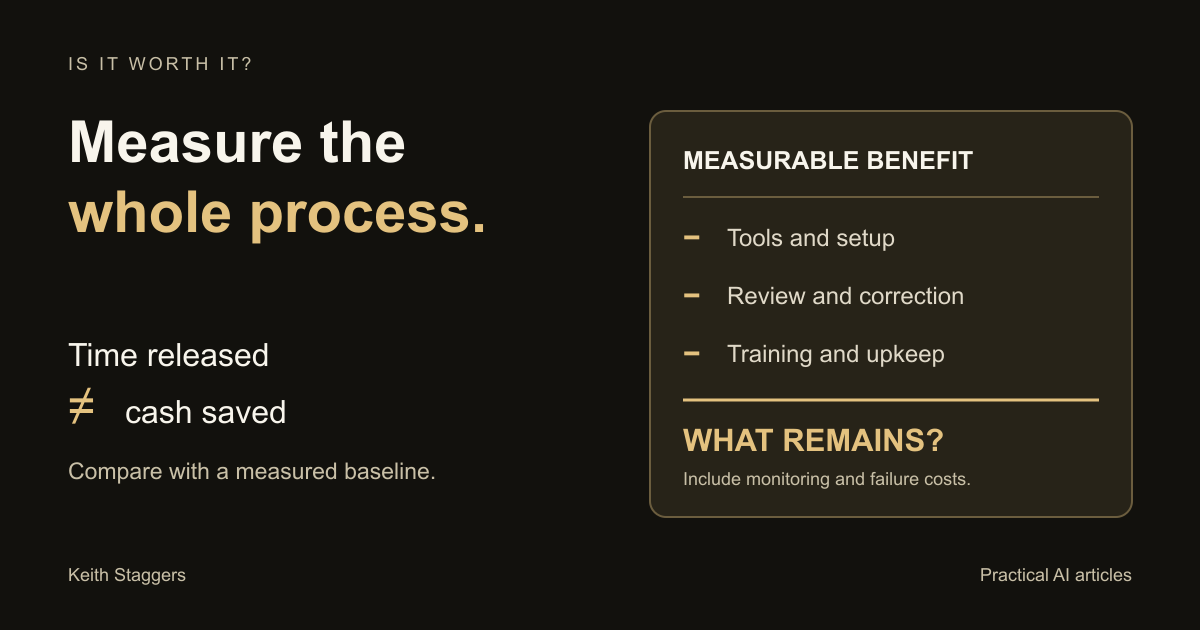
Measure the complete process, not only the AI step.
Calculate AI workflow ROI by comparing the complete approved process with the current baseline, then subtracting licenses, setup, review, correction, training, maintenance, monitoring, and expected failure costs from the measurable benefit.
- Measure the current process before changing it.
- Include review, correction, training, maintenance, monitoring, and expected failure costs.
- Separate time released from actual cash savings or contribution margin.
- Use a bounded pilot and a named go, revise, or stop decision.
The timer is still running after AI finishes the draft. Someone has to check the sources, fix the errors, obtain approval, and deliver the work. Stop measuring before those steps, and the spreadsheet will make the tool look more profitable than the process is.
Compare the time and cost of that complete process with the way your team works today. Then decide what the released time is worth. It may allow more work to get done without reducing payroll or producing cash savings.
The weekly-update example below shows how those calculations fit together. The approach follows the U.S. Small Business Administration's small-business finance guidance: compare benefits and costs over a defined period, and distinguish recurring expenses from one-time costs.
Start with the business question
Name the decision the measurement must support:
- Should we continue the pilot?
- Should we expand from one task to a second task?
- Should we buy the paid plan?
- Should we build an integration or keep the manual copy-and-paste step?
- Did the workflow release useful capacity without lowering quality?
“Prove AI works” is not a measurable business question.
Measure the current baseline first
Choose a representative period or set of completed cases and record:
- volume per week or month;
- end-to-end minutes per approved item;
- first-pass acceptance rate;
- correction or rework time;
- error, omission, and duplicate rate;
- direct outside cost;
- delay or backlog; and
- a quality measure tied to the task.
Use the same definition of complete in the baseline and the pilot. If the manual measure ends at “draft created” but the AI measure ends at “approved and delivered,” the comparison is not valid.
Use these four calculations
1. Monthly capacity value
Monthly capacity value =
monthly completed volume
× (baseline minutes − AI-assisted minutes)
÷ 60
× loaded hourly labor cost
AI-assisted minutes must include preparation, prompting, waiting, human review, correction, exception handling, and delivery.
Loaded hourly cost may include wages plus the employer costs the business normally uses for planning. If the organization does not have an approved loaded rate, report hours released instead of inventing one.
2. Other measurable benefit
Add only documented benefits that do not duplicate the capacity calculation:
- hard-dollar spending avoided;
- incremental contribution margin from additional completed work;
- avoided overtime actually removed;
- avoided vendor expense; or
- measurable reduction in rework, refunds, or waste.
Do not count the same hour as labor savings, new revenue, and avoided overtime.
3. Monthly total cost
Monthly total cost =
licenses and usage
+ setup cost amortized over the chosen period
+ training
+ maintenance and monitoring
+ review and correction not already included in cycle time
+ integration and support
+ expected error or incident cost when it can be estimated responsibly
Keep one-time and recurring costs visible even when the summary uses an amortized amount.
4. Net benefit and ROI
Monthly net benefit = monthly gross benefit − monthly total cost

ROI % = (monthly net benefit ÷ monthly total cost) × 100

Payback months = one-time setup cost ÷ positive monthly recurring net benefit
When monthly net benefit is zero or negative, there is no positive payback period under the tested assumptions.
Work through the numbers
Imagine a four-person business prepares 20 routine, nonconfidential project updates each week.
Suppose the manual process averages 25 minutes per approved update, and an AI-assisted process takes 14 minutes, including preparation, review, correction, and delivery. Monthly volume is approximately 86.6 updates using 4.33 weeks per month.
Capacity released:
86.6 × 11 minutes ÷ 60 = 15.9 hours per month

Capacity value at an approved $40 loaded hourly rate:
15.9 × $40 = about $635 per month
The workflow costs are:
- $60 monthly tool cost;
- two hours, or $80, for monthly maintenance and sampling; and
- $600 of one-time setup amortized over six months, or $100 per month.
Monthly total cost = $60 + $80 + $100 = $240
Monthly net capacity value = $635 − $240 = $395
Illustrative ROI = $395 ÷ $240 × 100 = about 165%
That is not automatically $395 in cash. If the released time is absorbed by idle time, the business has documented capacity but not a financial return. If the team uses it to complete paid work, eliminate paid overtime, reduce outside expense, or avoid a hire, the organization can document the corresponding financial benefit without double counting.
Put quality and risk beside the dollar figure
Financial ROI does not authorize an unsafe workflow. Track guardrails with the economic measures:
| Measure | Why it matters |
|---|---|
| First-pass acceptance | Shows whether faster drafts are usable |
| Factual or field defect rate | Detects quality loss hidden by speed |
| Human correction minutes | Captures work moved downstream |
| Stop and exception rate | Shows how often the normal process cannot finish |
| Duplicate or unapproved outside actions | Should be zero for the tested workflow |
| Restricted-input control pass rate | Hard-stop tests should pass every time |
| Manual fallback completion time | Confirms the essential job can continue |
| User adoption and override reports | Reveals whether the process works in practice |
NIST’s AI RMF Core recommends quantitative, qualitative, or mixed methods to measure AI risk and impact, testing under conditions similar to deployment, monitoring behavior in production, and documenting performance improvement or decline.
Run a 30-day small-team pilot
Before the pilot
- Define the task and completion standard.
- Measure at least a representative sample of manual cases.
- Set the quality, privacy, security, and outside-action hard stops.
- Record all expected one-time and recurring costs.
- Name the person who will make the final go, revise, or stop decision.
During the pilot
- Use sample or approved information.
- Keep human approval before outside actions.
- Record end-to-end time and correction time.
- Record failures and near misses, not just successes.
- Sample outputs against the approved source.
At the decision point
Compare the pilot with the baseline. Report hours released, financial benefit actually realized, total cost, quality change, unresolved risk, and user experience separately.
Choose one outcome: continue within the tested boundary, revise and retest, or stop.
Common ROI mistakes
- Measuring generation time instead of approved completion time.
- Ignoring review, correction, training, and maintenance.
- Pricing every saved minute as cash.
- Using vendor estimates instead of local baseline data.
- Counting the same benefit twice.
- Averaging away a serious failure.
- Expanding the workflow before the first use case is stable.
- Treating adoption as proof of quality or safety.
Limitations
The formulas are planning tools, not accounting, tax, legal, or investment advice. Use the organization’s approved financial assumptions and involve finance, legal, privacy, security, clinical, and operational owners when relevant.
Short pilots may miss seasonal volume, rare failures, maintenance burden, price changes, and model drift. Continue measuring after deployment, and revisit the business case when the workflow or its consequences change.
Primary sources
- U.S. Small Business Administration: Manage Your Business and Cost-Benefit Analysis
- U.S. Small Business Administration: Calculate Your Startup Costs
- NIST AI RMF Core
- NIST AI RMF Playbook
- NIST AI Risk Management Framework
Written by Keith Staggers, AI trainer, workflow builder, nurse leader, and author. Last reviewed August 20, 2026.
What to do next