Article · 05 / Content marketing
How to turn one strong idea into content for six channels.
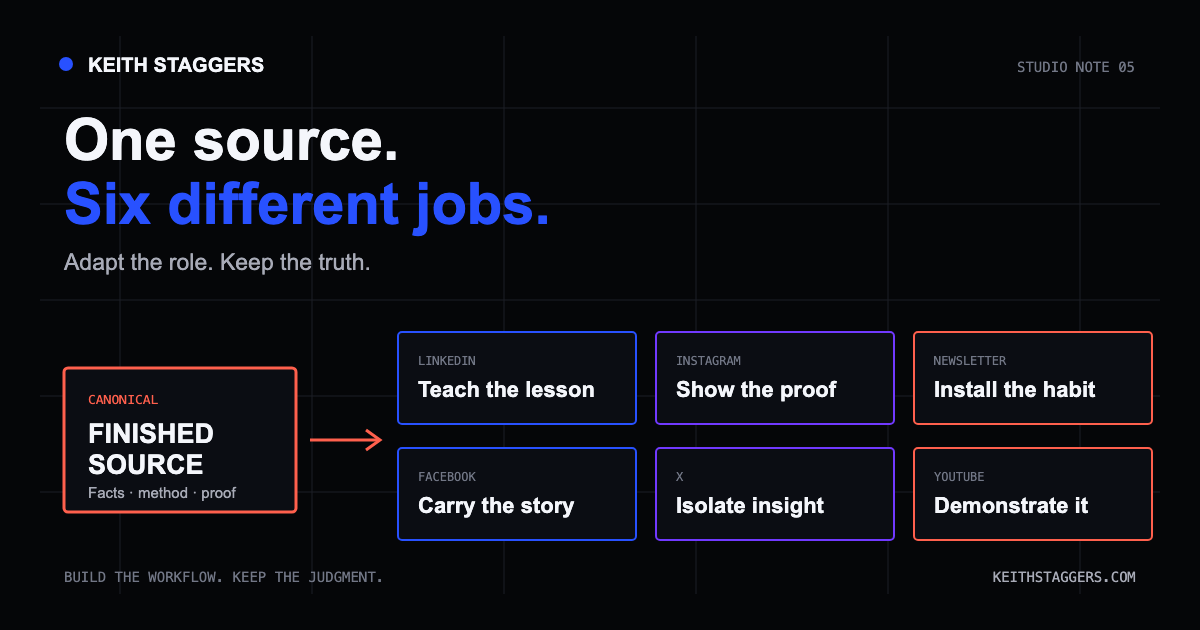
In brief
Keep one accurate source. Adapt the message for each channel.
Use one accurate website article or finished project as the main source. Give LinkedIn, Facebook, Instagram, X, email, and YouTube different versions, and approve each public item before it is published.
- Finish and verify one main source before creating versions for other channels.
- Give LinkedIn, Facebook, Instagram, X, newsletter, and YouTube different roles.
- Keep the fact source, approval, visual, date, and public link with every item.
- Measure each channel by the useful next action it was designed to support.
01
Finish the main source first.
Turning a loose thought into six drafts creates six places for confusion to spread. Finish one strong source with a clear point, checked facts, a useful structure, and a defined ending before adapting it for other channels.
A website article works well when the idea needs a full explanation. A finished project, public video, or released product can also be the main source. Keep the complete version in one place so later corrections begin there.
02
Do not copy the same post everywhere.
The main source protects the full explanation and the facts. Each channel needs the language and format people expect there. Copying the same caption across every platform ignores why someone opened that platform.
Adapt the presentation, not the facts. The main point and important limits stay the same. The opening, pacing, example, visual, and next action can change because each channel has a different job.
03
LinkedIn teaches the professional lesson.
LinkedIn should contain a complete useful lesson, not a teaser that withholds the important part. Lead with a familiar work problem, explain the choice, name the limit, and give the reader one action they can use. One link to the full article is enough when more context helps.
The professional version should connect the idea to using AI at work, leadership, or production. It does not need a résumé paragraph or an invented business result. Credibility comes from making the decision clearer and explaining why it works.
04
Facebook and Instagram carry different kinds of context.
Facebook earns the fuller personal bridge when a real story explains why the idea matters. The audience may know the music, the books, or an earlier chapter of the work. The post can connect that history to the current method without forcing a business pitch into every memory.
Instagram needs visual proof. A process clip, diagram, before-and-after asset, or concise carousel can carry the idea. If the source has nothing worth seeing, the system should skip Instagram instead of putting a paragraph on a portrait and calling it visual content.
05
X isolates the insight. The newsletter installs the habit.
X works when one sentence carries a useful distinction, or when a short thread earns each next post. It does not need the full setup from LinkedIn. The strongest line may be the rule, the exception, or the mistake that changed the process.
The newsletter has a different promise. It enters an inbox, so it should give the reader one repeatable process, one safety rule, and one action. The full article can hold the complete explanation. The email should make one part easier to use this week.
06
YouTube demonstrates only what can be shown safely.
A short video should reveal a decision, a visible step, or a finished artifact. A longer demonstration belongs only when the screen can be shown without employer data, private material, secrets, staged customer claims, or a fake result. A script cannot manufacture proof the source does not contain.
The video version needs its own opening, on-screen text, visual sequence, and close. Reading the Note into a camera may preserve the words, but it usually wastes the job video can do: let the viewer see the process move.
07
Keep the source and approval with every version.
Each draft should keep a link to the fact source, the channel, exact words, visual when present, planned time, approval, and final public link. If the words or image change after approval, the item must be reviewed again. Approval of a text post does not approve a visual post.
Automation can create files for each channel, check required information, place exact approved items in a queue, and record the public link. It cannot treat silence as approval, invent a result, or turn approval of one item into permission for every later version.
08
This article is the example.
The main idea is simple: one finished idea can do different jobs without becoming six unrelated messages. This article is the full source. LinkedIn would teach the professional lesson. Facebook would need a real personal connection. Instagram would use the diagram. X would isolate one rule. The newsletter would give one repeatable action. YouTube would demonstrate the process only if the screen contained no private material.
Not every version needs to be published. The useful measure is not the number of channels. It is whether each published version did its intended job without weakening the truth of the original.
What to do next
Related resources and services.
- Read all articles and guides → Keith's main archive of practical writing about AI, work, and finishing projects.
- Use The Finish Loop → Choose, make, review, revise, and finish the source before creating more versions.
- See examples of Keith's work → Independent AI projects, client work, books, and finished creative projects.
Use this idea